
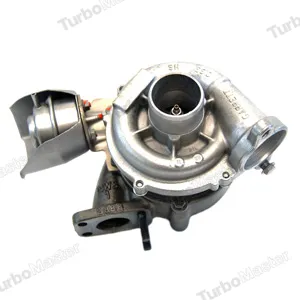
FOR: PEUGEOT 307 FACELIFT AND DV6TED4 FAP TURBO DIESEL |
|
|---|---|
| CUSTOMER SYMPTOM | Lack of power – Engine diagnostic warning light on – Noisy turbocharger – Large amount of exhaust smoke |
| CONDITIONS OF OCCURRENCE | Both cold and hot |
1. ORIGIN
Turbocharger.
2. AFTER-SALES ACTION
MANDATORY: Before any work, read the fault codes to confirm the turbocharger malfunction, using the diagnostic tool (in guided mode).
CAUTION: Check the engine mileage: some operations depend on the mileage.
Read the fault codes. Checks:
- Air filter: replace the air filter (if necessary)
- Air intake line
Replace the oil dipstick. Remove and inspect the oil sump.
Replace:
- Oil sump
- Turbocharger (if necessary)
2.1. Parts required
- 1 air filter.
- 1 oil filter cartridge.
- 1 turbocharger air inlet hose.
- 1 turbocharger air inlet union (with a seal).
- 1 oil dipstick (part no. P.R 1174 E6).
- 1 oil pick-up strainer.
- 1 oil sump.
- 1 turbocharger.
- 1 turbocharger oil feed pipe (with 2 banjo bolts and their seals).
- 1 oil return pipe.
- 1 oil return union (with a seal).
- 2 turbocharger gaskets (part no. P.R 1440 81).
2.2. Recommended product
[1] ARDROX leak detector.
2.3. Reading the fault codes
NOTE: List of turbocharger fault codes: see workshop documentation: Service Box / Vehicle / Diagnosis / Selected language / Diagnostic help / Under bonnet / Variable geometry turbocharger
Read the fault codes:
- If turbocharger fault codes are present: apply the diagnostic help of the diagnostic tool
- If other fault codes are present: carry out a thorough fault search; contact the assistance platform
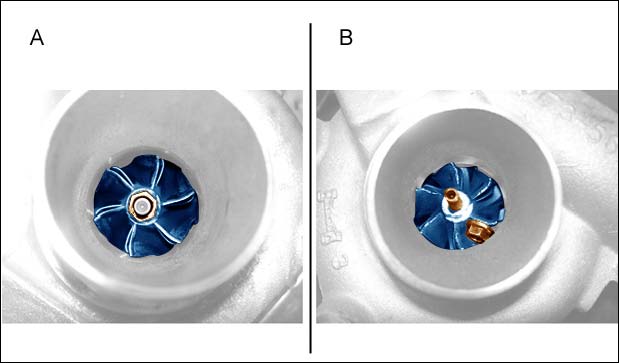 Act if the diagnostic tool proposes removing the turbocharger and the following conditions are found:
- Broken turbo shaft
- Excessive bearing play: contact between the wheels and the housings (compressor side) – contact between the wheels and the housings (turbine side) (Figure "A")
- Missing or loose nut (compressor side) (Figure "B")
2.4. Procedure
MANDATORY: To remove the risk of the turbocharger malfunction recurring and to avoid damaging the new turbocharger when the engine is restarted, carry out the following operations when replacing the turbocharger. The air intake circuit must be clean.
Check: the air filter; replace it (if necessary).
Clean: the air filter housing.
Check:
- No foreign bodies in the air line (upstream of the turbocharger); clean (if necessary)
- No blockages in the hoses at the front of the turbocharger; clean (if necessary)
- No pinching of the turbocharger hoses; replace (if necessary)
- No foreign bodies in the air line (downstream of the turbocharger); clean (if necessary) No foreign bodies at the cylinder head cover outlet of the oil vapour recirculation circuit; clean, preferably by suction – if necessary, run a magnet through the bends and the valve
 Drain the residual oil from the resonator.
Replace:
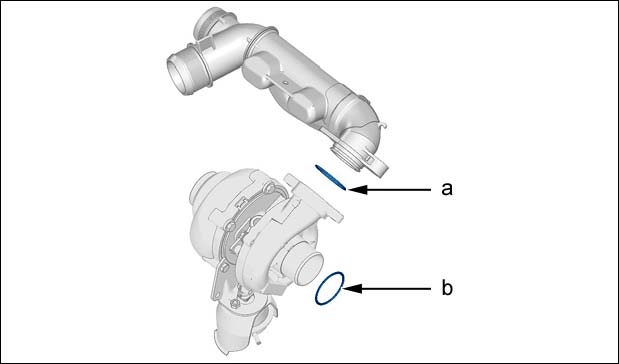
- The orange seal at the turbocharger inlet on the turbocharger inlet union (at "b")
- The O-ring of the turbocharger air intake union (at "a")
Remove: the air-to-air heat exchanger (intercooler):
- Check that there is no oil or foreign bodies
- Turn the intercooler upside down and wait 15 minutes; if there is oil or foreign bodies, rinse the intercooler with solvent
Check that the compressor wheel retaining nut is present.
NOTE: The compressor wheel retaining nut may be loose or missing after a very sudden stop of the rotating assembly (lack of lubrication – foreign bodies on the compressor side)
MANDATORY: If the compressor wheel retaining nut is missing when the turbocharger is removed, find it to avoid any risk of recurrence
Replace: the oil dipstick (if the dipstick is plastic with a yellow handle, replace it with a white composite dipstick with an orange handle, whose accuracy at the level marks has been improved).
CAUTION: Steps 1 to 4 must be carried out if the engine mileage is over 60,000 km
Step 1.
Loosen: the oil filter cartridge.
Drain the engine oil through the drain plug.
Remove: the engine oil sump.
Step 2.
Check the condition of the oil and of the oil sump walls:
- If the oil is thick: contact the assistance platform
- If the oil looks correct: carry out step 3
Step 3.
Check the oil pick-up strainer for clogging:
- If one of the pick-up strainer fixing screws is loose: replace the strainer
- If the pick-up strainer mesh has deposits: replace the strainer
- If everything is correct: carry out step 4
NOTE: When removing the pick-up strainer, tap the fixing screws firmly with a punch before loosening them to avoid breaking them
Step 4.
Fit the new oil sump.
NOTE: End of the operations to be carried out if the engine mileage is over 60,000 km
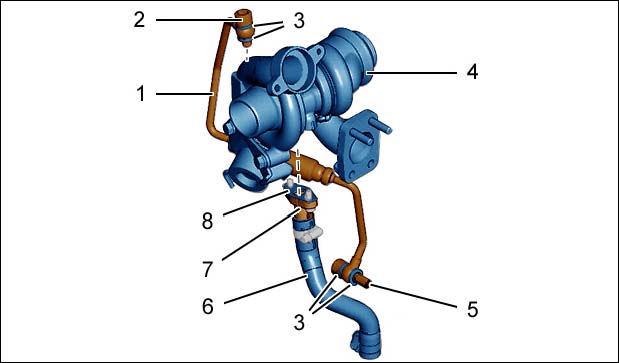
- (1) Turbocharger oil feed pipe.
- (2) Banjo bolt.
- (3) Banjo bolt seals.
- (4) Turbocharger.
- (5) Banjo bolt.
- (6) Oil return pipe.
- (7) Turbocharger oil return union.
- (8) Oil return union seal.
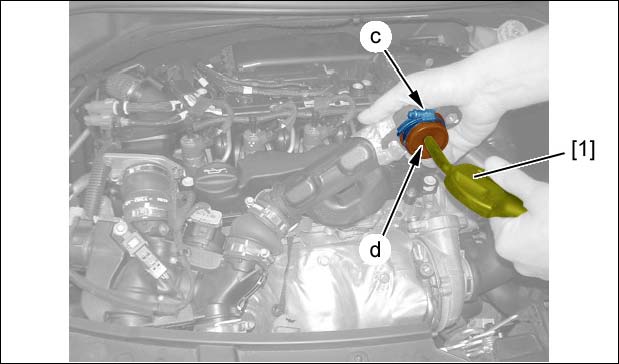
MANDATORY: An air leak downstream of the turbocharger makes the turbocharger spin too fast to deliver the requested air pressure, and therefore causes turbocharger malfunctions
Check the air line for leaks (before fitting the new turbocharger).
Make a hole in the centre of the red blanking plug to insert the nozzle of an air blow gun (at "d").
Spray the leak detector [1] over the whole turbocharger / intake manifold area.
Fit: the red blanking plug, with a clamp, on the turbocharger outlet union (at "c"):
- Blow into the air line: check that there are no bubbles, especially at each union between 2 elements of the air line, from the turbocharger outlet union to the intake manifold
- Repair the air leaks (if necessary)
- Remove: the red blanking plug
Always replace the turbocharger together with the following parts:
- The oil feed pipe (1)
- The banjo bolts (2), (5)
- The banjo bolt seals (3)
- The oil return pipe (6)
- The oil return union (7)
- The oil return union seals (8)
Remove: the vacuum pump.
CAUTION: Clean the oil inlet strainer of the vacuum pump
Replace: the oil cartridge.
Fit: the drain plug (with a new seal).
Fill the engine with the recommended quantity of new oil for the engine concerned.
Fit:
- The filler cap
- The oil dipstick
Prime the oil circuit.
Precautions before starting the engine:
- Disconnect: the injector connectors
- Crank the engine with the starter motor (for 15 seconds)
- Reconnect: the injector connectors
- Clear the fault codes
Start the engine: let it idle without accelerating for 5 minutes so that the turbocharger bearings reach the correct pressure.
Stop the engine: wait 15 minutes.
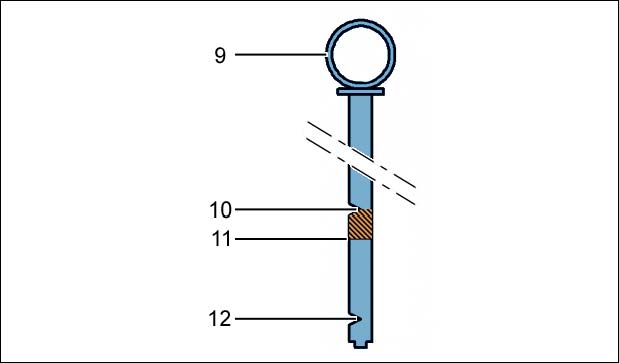
- (9) Oil dipstick.
- (10) Max mark.
- (11) 3/4 mark.
- (12) Min mark.
Check the oil level.
NOTE: The level should be as close as possible to the max mark (10) without exceeding it, and between marks (10) and (11) (for reference: min mark (12) = 0%, max mark (10) = 100%, mark (11) = 3/4)
Top up the oil level (if necessary).
Carry out a road test including at least one full-load run at the end.
Check: that there are no fault codes; if the ECU shows fault codes, carry out a thorough fault search.
Visually check the condition of the turbocharger blades by disconnecting the turbocharger air inlet union:
- If the leading edges of the blades are damaged: find the foreign body responsible for the first failure
- If the compressor wheel touches the housing: contact the assistance platform
- Reconnect: the turbocharger air inlet union
2.5. Labour time: 206
Mileage under 60,000 km:
- Time: 7.70
- Operation code: 99575A
Mileage over 60,000 km:
- Time: 11.70
- Operation code: 99615A
2.6. Labour time: 207
Mileage under 60,000 km:
- Time: 7.20
- Operation code: 99570A
Mileage over 60,000 km:
- Time: 9.00
- Operation code: 99588A
2.7. Labour time: 307
Mileage under 60,000 km:
- Time: 6.90
- Operation code: 99567A
Mileage over 60,000 km:
- Time: 9.00
- Operation code: 99588A
2.8. Labour time: 308
Mileage under 60,000 km:
- Time: 7.10
- Operation code: 99569A
Mileage over 60,000 km:
- Time: 8.60
- Operation code: 99584A
2.9. Labour time: 1007
Mileage under 60,000 km:
- Time: 8.40
- Operation code: 99582A
Mileage over 60,000 km:
- Time: 10.20
- Operation code: 99600A
2.10. Labour time: 407
Mileage under 60,000 km:
- Time: 6.00
- Operation code: 99558A
Mileage over 60,000 km:
- Time: 7.40
- Operation code: 99572A
2.11. Labour time: PARTNER 2
Mileage under 60,000 km:
- Time: 7.10
- Operation code: 99569A
Mileage over 60,000 km:
- Time: 10.50
- Operation code: 99603A
Send an incident report (CRI) for any recurrence after applying this information.