
Introduction
Cutting fuel consumption by reducing engine size and displacement ("downsizing") and engine speed ("downspeeding") is increasingly important for an automotive industry working to meet strict emissions standards. Drivers also expect better low-end torque and transient response for a more enjoyable driving experience. To deliver both good performance and efficient fuel use, the leading original equipment manufacturers have adopted different powertrain electrification approaches, such as 48-volt electrical systems. BorgWarner's second-generation eBooster brings significant improvements in both the efficiency and the performance of high-voltage electric charging, providing high-power electric boosting for higher low-end torque and transient response without turbo lag.
The use of electrically driven compressors keeps growing and supports vehicle electrification, as it allows new voltage thresholds to be reached and brings advances in electric motor technology, electronics and microprocessors. Designed as a two-stage system in which the turbocharger handles full-load operation, BorgWarner's second-generation eBooster maximises efficiency at low loads. With faster response and efficient boost pressure generation, this innovative compressor can deliver 10 kW at 48 V power levels on much smaller engines. Higher engine power is achieved by separating electric boosting from the turbocharger, so that the turbocharger can be matched for higher power, which lowers exhaust manifold pressure and improves gas exchange.
Continuous innovation
BorgWarner's 48 V electrically driven compressor was first launched in 2017. Now comes the second-generation eBooster, in series production since early 2020. Development of the "Gen2" model had two main goals: to improve operating efficiency and to allow continuous operation at 2.5 kW. The previous model only allowed transient boosting of up to 5 kW for 20 seconds per minute.
The first-generation eBooster used a permanent magnet synchronous (PMS) motor, which considerably reduced the energy needed during acceleration compared with a traditional reluctance motor. The PMS motor also significantly improved NVH and motor response, as well as torque density and efficiency. Building on these advantages, BorgWarner has kept the permanent magnet electric motor in the latest eBooster. To improve performance even further, the moment of inertia of the rotor and the compressor has been reduced, lowering energy consumption and speeding up torque build-up. Table 1 gives a detailed comparison of the Gen1 and Gen2 models.
| Specification | Unit | Gen1 | Gen2 |
|---|---|---|---|
| Speed | rpm | 70,000 | 72,000 |
| Spool-up to 90 % of target speed | ms | 270 | 190 |
| Max. power | kW | 5 | 7 |
| Max. current | A | 130 | 160 |
| Max. pressure ratio | – | 1.45 | 1.6 |
| Max. air mass flow | kg/h | 500 | > 600 |
| Max. duty cycle | % | 35 | 100 |
| Max. boost duration | s | 21 | Permanent |
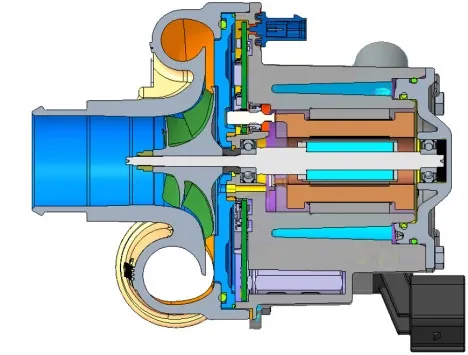
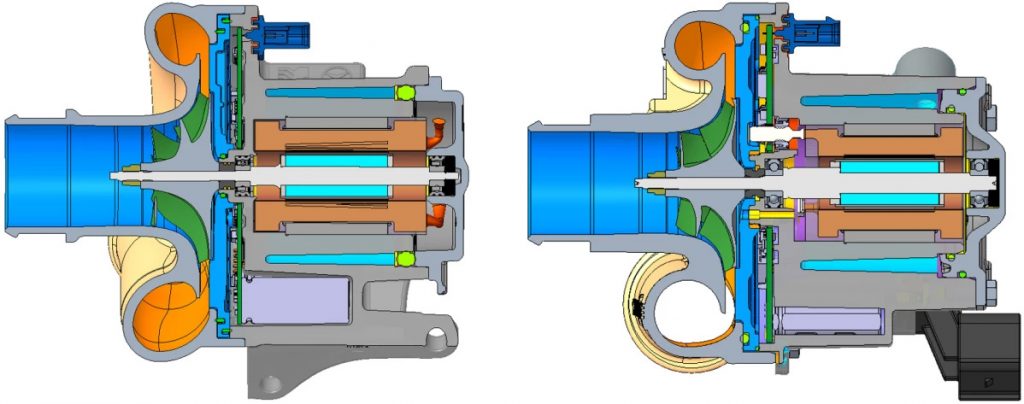
The Gen2 eBooster includes many further improvements: a compressor with reduced inertia that increases energy efficiency, a stiff rotor designed for higher speeds, a new EMC choke designed to reduce power losses and improve filtering, a stator connected to the power electronics to reduce resistance and improve efficiency, a microcontroller with extra computing power for field-oriented control (FOC), and a model-based software component protection that allows uninterrupted operation. Fig. 1 shows cross-sections of the Gen1 and Gen2 so you can see the similarities and differences between them.
Benefits of sinusoidal commutation
Another major improvement of the Gen2 eBooster over the Gen1 is the use of sinusoidal commutation instead of block commutation. Sinusoidal commutation gives a smoother transition and generates less current ripple than block commutation, where changes are more abrupt. It also reduces eddy-current losses in the electric motor, which can therefore deliver higher peak power and allow the eBooster to run continuously. From the DC voltage, a three-phase commutation with variable amplitude and frequency is generated to drive the PMS motor, and a sensorless FOC algorithm generates the signals for the switches of the three half-bridges of the power stage. Table 2 highlights the advantages of sinusoidal commutation over block commutation.
| Block commutation | Sinusoidal commutation |
|---|---|
| Steep commutation every 60° | "Soft" commutation |
| Only two phases energised | All three phases energised |
| Lower computing power | Higher computing power |
| Higher torque ripple | Smaller torque ripple |
| Acceptable NVH | Improved NVH |
| Limited efficiency | Higher efficiency |
For operating points at very low voltages or very high speeds with low torque requirements, FOC allows the PMS motor to run in a field-weakening region, splitting the phase currents into two vectors: magnetising current (id) and torque-producing current (iq).
Other notable design features of the new Gen2 eBooster are faster current and speed control, current measurement on all three phases, a 40 µs PI controller cycle time, 28 kHz PWM, overload protection in hardware and software, and permanent boosting made possible by model-based component protection.
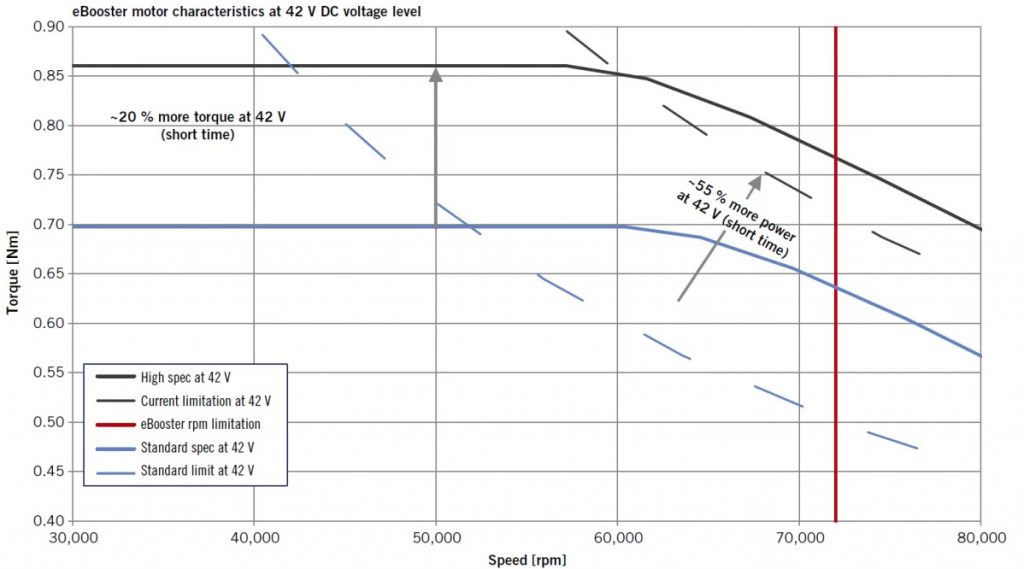
Fig. 2 details the performance gains from FOC, including electric motor power and torque against electric motor speed. The higher power output comes from the new EMC filter, which allows a stronger DC supply. In 48 V systems under load and with a reasonable state of charge, the voltage is typically 42 V. The limits at low voltage and higher speeds can now be raised by 55% for short periods thanks to the positive effect of field weakening.
Advanced component protection
To improve component protection, the printed circuit board (PCB) of the Gen2 eBooster has three NTC thermistors that measure coolant temperature in key areas, as well as the power electronics on the PCB. A sophisticated model is used to estimate these critical temperatures from the sensors. Intelligent power derating of the eBooster then protects the components based on the maximum permissible temperatures in critical areas.
This temperature-based model protects the eBooster components from excessive thermal load even under the most demanding conditions. The calculated temperatures are converted into a percentage range from which a utilisation index is built; the highest temperature sets the utilisation percentage sent to the electronic control unit over the CAN interface. Temperature warnings and an "overtemperature" alert can thus be defined according to the utilisation index.
New EMC filter design
As in the first-generation model, the Gen2 eBooster has an EMC filter between the main PCB and the DC supply. Achieving the twin goals of higher power and lower cost called for a new design. A new concept was developed in which the choke was optimised to act as a filter in both common mode and differential mode.
In the Gen2 eBooster, the differential-mode choke and the common-mode choke are a single part. In this new design, the ferrite core uses the outer ferrite ring as the path for common mode, and the tongue combined with an air gap and the outer ring as a defined path for differential mode. This keeps DC losses low thanks to the low current density of the busbars, while differential mode can be tuned through the core design, which keeps most of the flux inside the ferrite core.
Improved efficiency for commercial vehicle applications
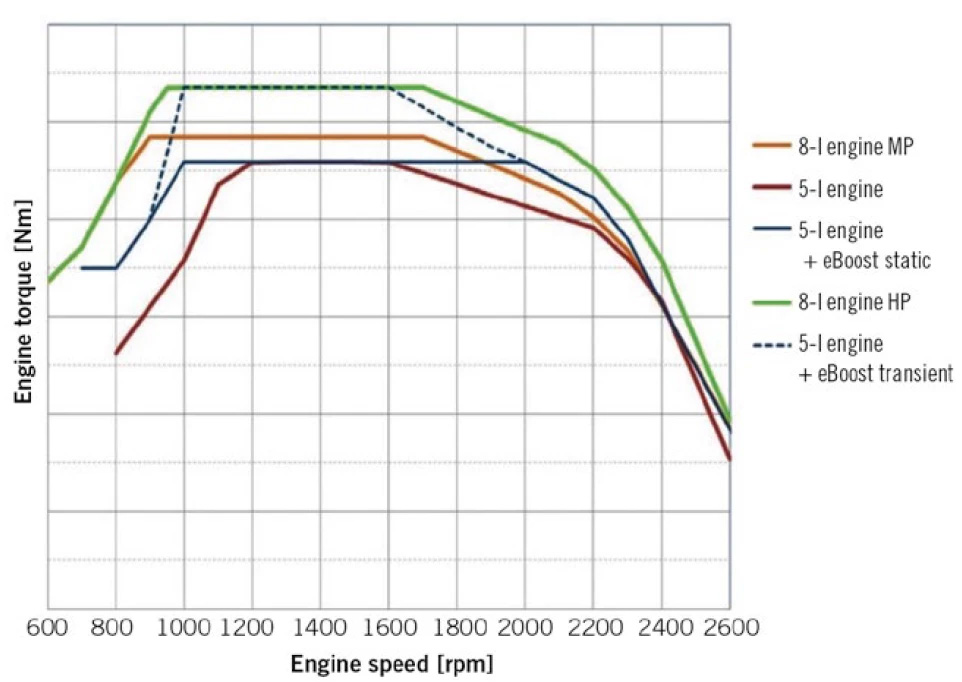
Thanks to its configuration, BorgWarner's Gen2 eBooster can also be used in commercial vehicle applications with displacements of up to 5 litres. The extra combustion air this boosting technology adds now makes it possible to use medium-sized engines to replace models up to 50–60% larger without losing power or torque, while keeping or even improving transient behaviour. Fig. 3 compares dynamometer test-bench results on stationary engines with different concepts.
Summary
BorgWarner's advanced eBooster technology improves conventional turbocharging systems by enabling engine downspeeding and downsizing, and with them lower fuel consumption. The latest model, Gen2, uses the 48 V on-board network for 7 kW of electric power and, thanks to more sophisticated motor controls, offers continuous operation at 2.5 kW. This optimises low-end torque when the engine runs at steady state. The efficiency of the power electronics, electric motor and compressor has been improved, giving excellent overall efficiency and a lower load on the vehicle's electrical system. Further major advances have also been made in electromagnetic compatibility and NVH. The Gen2 eBooster provides boost pressure even at low engine speeds, with a torque build-up time of less than 190 milliseconds, ensuring exceptional engine response. These benefits are now available for both passenger car and commercial vehicle applications.