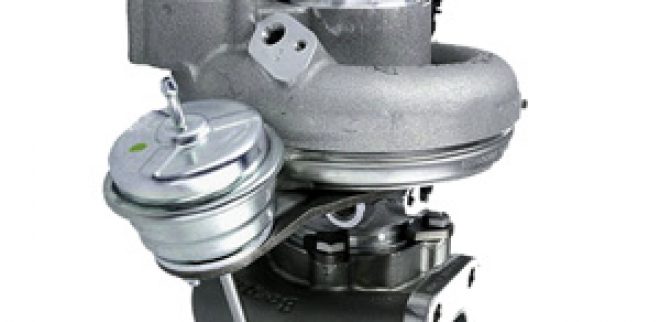
e-Turbo
Challenges for Commercial Trucks
- Better fuel economy.
- Lower emissions.
- Longer lifetime.
Turbocharged Engine Challenges
Standard Setup
- Turbo lag: low rpm engine torque, slow time-to-torque.
- Larger engine or higher speed engine used to make up acceptable levels of torque and response.
- Fuel economy suffers due to larger or higher speed engine.
- Under certain conditions there’s an excess of energy in the exhaust stream that goes under-utilized.
Turbocharged Engine Benefits
with eTurboTM
- Single-machine solution for electrified boost assitance and recuperation.
- Reduced turbo lag: better low rpm engine torque, faster time-to-torque.
- Smaller engine or lower speed engine can be used and have acceptable levels of torque and response.
- Fuel economy improves due to downsized or lower speed engine.
- Wasted exhaust energy is converted to electrical energy.
eTurboTM
How it works
- A turbocharger with a (single-shaft) motor attached, can serve as either a motor or a generator.
- Electric motor can assist the compressor to provide supplemental boost air to the engine.
- Electric motor (generator) can be driven by excess turbine energy from the exhaust flow.
- Electrical function can be turned off to be returned to normal turbocharger function.
- Can help drive EGR on demand due to intentional backpressuring of the engine.